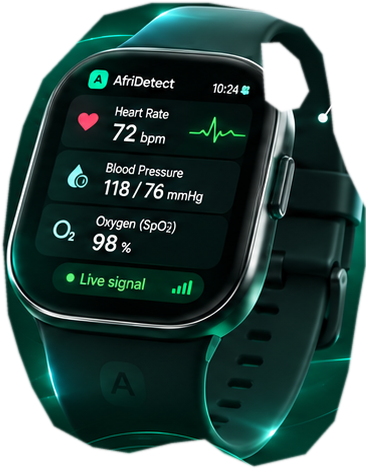
AfriDetect Vitals Watch
Maternal vitals monitoring
Heart rate, blood pressure, and oxygen context designed to feed Nigerian obstetric early-warning bands and the hypertensive miniPIERS pathway.
- Heart rate
- Blood pressure
- Oxygen (SpO₂)
AI for early risk detection
AI detects risk early and guides what to do next.
An AI-powered clinical risk detection, monitoring, and decision-support ecosystem for mothers and care partners.
Clinical alerts
Risk detection · care guidance · escalation
AfriDetect Vitals Watch
Maternal vitals monitoring
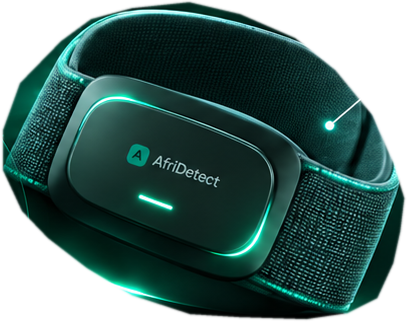
AfriDetect PalmBand
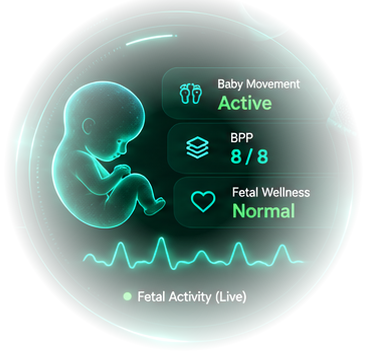
Baby BPP & activity monitoring
Four data collection points
AfriDetect joins four connected capabilities into one patient record. Devices are one source — not the whole product.
01
History triage, registration, symptoms, risk factors, and patient-reported details.
02
Heart rate, blood pressure, SpO₂, temperature, and supported maternal or fetal signals.
03
Clinician notes, diagnoses, medicines, labs, visits, and treatment history.
04
Questions and conversations. Suggestive only until History triage or a clinician confirms.
AfriDetect Clinical Intelligence Engine
Data integration → clinical analysis → risk prediction → continuous reassessment
Intelligence engine
Combined Risk draws on four clinical models — symptoms, vitals early warning, hypertensive triage, and antenatal registration scoring — so care guidance stays grounded in published evidence.
Symptom triage for maternal warning signs from History and confirmed reports.
Vitals bands from monitors and clinic readings for early warning.
Adverse-outcome pathway when blood pressure is high in pregnancy.
Booking-visit score from age, parity, blood pressure, family history, and urine protein.
Built for safe care
History, monitors, clinic notes, and companion chat stay linked to the right person.
Missing or outdated device readings are rejected before they change the risk score.
WHO danger signs, obstetric early warning, miniPIERS, and a registration risk score guide Combined Risk.
New History answers, monitor pulls, and EMR entries refresh the risk view.
High risk can notify care partners and stays open until a clinician acknowledges it.
Doctors remain responsible for diagnosis and treatment. AfriDetect shows findings and next-step guidance.
For families
Use History for a short check-in that updates Combined Risk. Use the AI companion when you want to ask about pregnancy, visits, or everyday care.
History
Short check-ins for early risk detection.
Companion
Ask maternal health questions anytime.
Family
Partner and children on one household record.
Learn
Short guides for warning signs and recovery.
Monitoring ecosystem
The Vitals Watch and PalmBand are examples inside Smart Monitoring. Ward monitors and clinic vitals use the same Combined Risk pathway.
AfriDetect Vitals Watch
Heart rate, blood pressure, and oxygen context designed to feed Nigerian obstetric early-warning bands and the hypertensive miniPIERS pathway.
AfriDetect PalmBand
A soft palmband concept for movement awareness — quieter days can be noticed earlier, then confirmed in History and with care partners.
Care partners
When Combined Risk is urgent or emergency, AfriDetect can notify configured partners and keep an open alert until a clinician acknowledges it in the EMR.